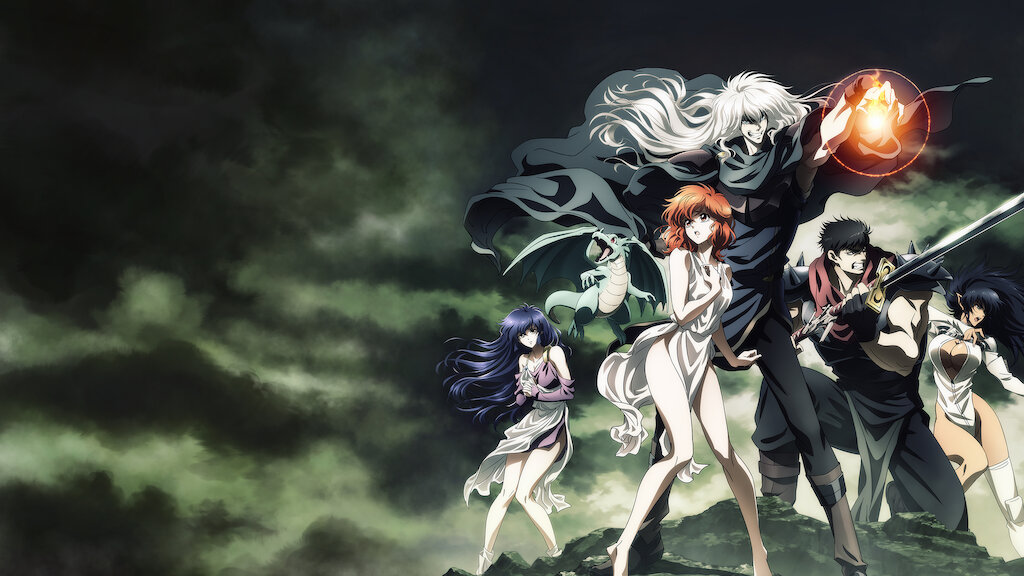
Literally that no anime like this is made nowadays, and if it is made, it rarely gets noticed
Indeed, as more than one will have sensed I never got to see the anime/read the original manga of “Bastard!!!”. In fact, when the franchise was born I hadn’t even done so yet, so you’ll excuse me for that part. However, I was well aware that this anime was not like the stuff that is produced today, especially from a sexual standpoint or uncennsored hentai. And boy has that very thing been confirmed to me. On the other hand, I have to say that my overall experience with the anime has not been negative at all.
Having said that, I just want to comment with you four little things that I found interesting about an anime like “Bastard!!!” that, again, I don’t think are done anymore nowadays:
-
- Bastard!!!, an anime that focuses on its protagonist being like Mourinho in the press rooms, in the words of Pep Guardiola: ‘El pu** amo’.
- Because yes, literally the things that happen in the anime are explained to you by Dark Schneider himself: ‘because I’m handsome, the hero chosen by the gods’. And that guy was a badass villain.
- But if I had to choose a set of keywords to describe what I’ve seen with Bastard!!! it would clearly be these: fantasy, absurd humor and ecchi galore. ❗
I’m sure the first two points won’t surprise anyone, they’re still pretty recurrent to this day. But the third one crosses the barrier of what we usually see in current anime on a constant basis and also without hardly expecting it.
Scenes in which, out of nowhere, Dark Schneider starts groping a girl without stopping. As if to say good morning.
Watch out with the volume: you know the meme moment when you are watching anime and your parents enter the room at the most inopportune moment? Well, with all the moaning that goes on in here, it’s a real drag.
- NO, BASTARD! It’s NOT HENTAI videos; it basically plays with ecchi even to the point of mockery. I remember a scene of Dark Schneider extracting venom from a girl and the camera angle positioned to make it look like he was eating her you-know-what. It’s ecchi, but the anime is also trollish as hell. ❗
- By all this what do I mean: if you hate cheap sexualization of women (which you really should), Bastard is not made for you. To watch this anime you have to go in with the mindset that it doesn’t offend you at all and that it really is almost a relic of anime’s past. ❗
If someone were to ask me the question: should there be more anime like “Bastard!!!”? Surely my answer would be: there is no need. However, I do like the particular existence of “Bastard!!!”, which is why I will watch part 2 when it is released on Netflix. I know my approach is strange as I keep throwing negatives and positives one after the other, but within the boundaries of today that “Bastard!!!” constantly crosses, lies a peculiar yesteryear phenomenon like few others.
In an era without law and order, dominated by demonic force, the kingdom of Meta=Llicarna suffers the onslaught of evil sorcerers. When all seems lost, Yoko, the high priest’s daughter, summons the devil man again, who had been sealed fifteen years before. His name is Dark Schneider and a new battle begins for the legendary devil man!!!